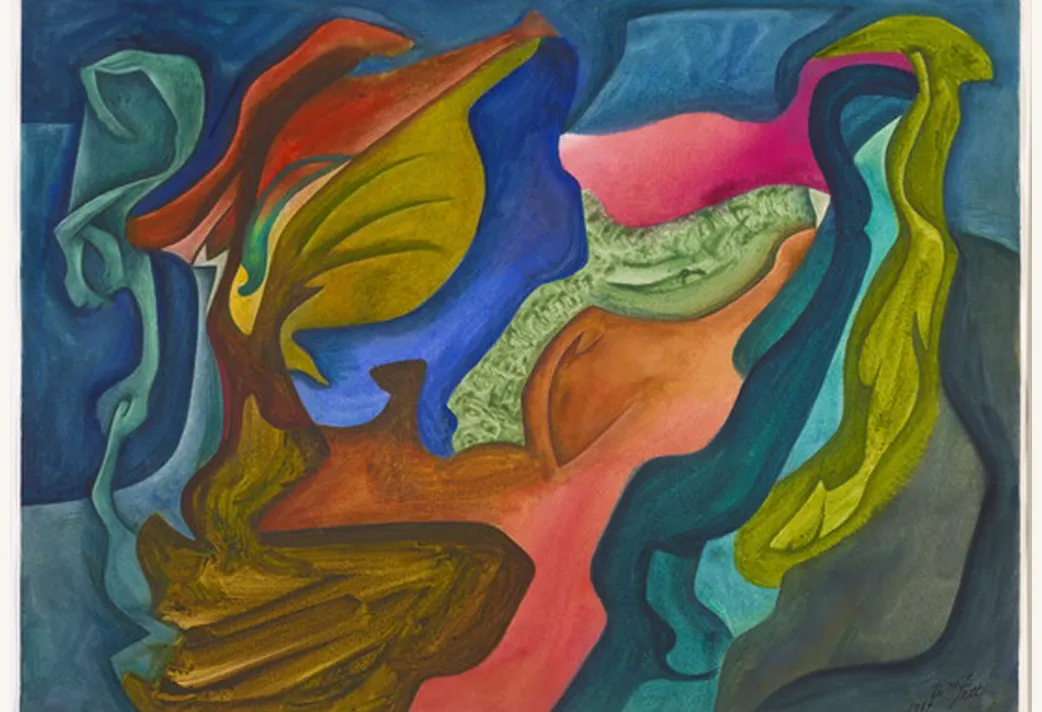
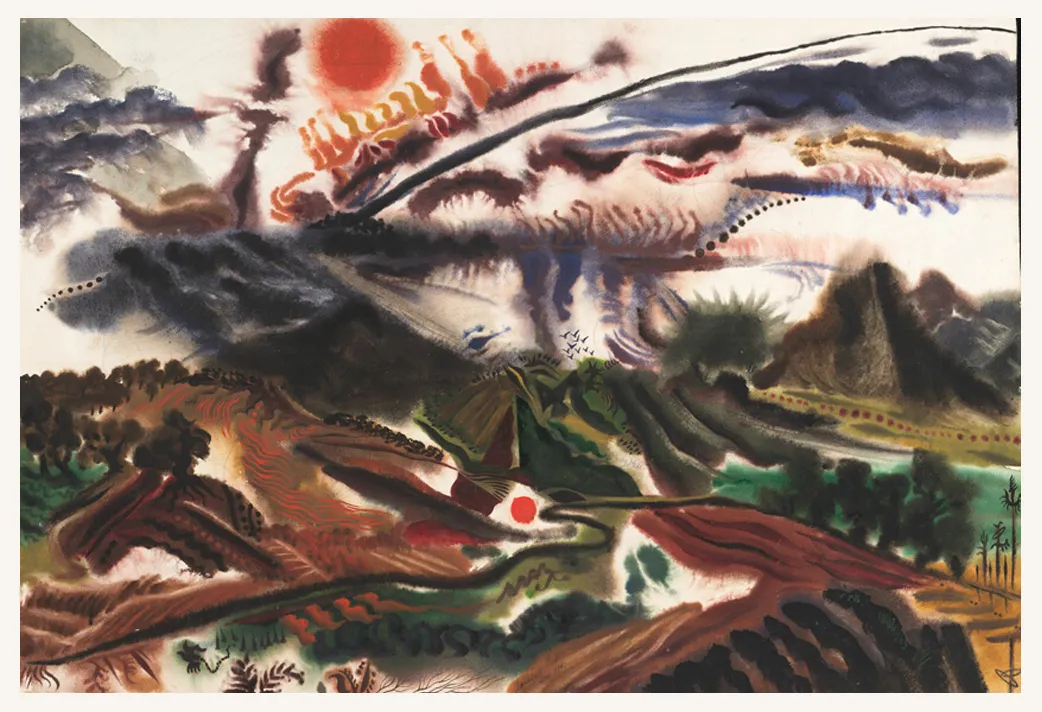
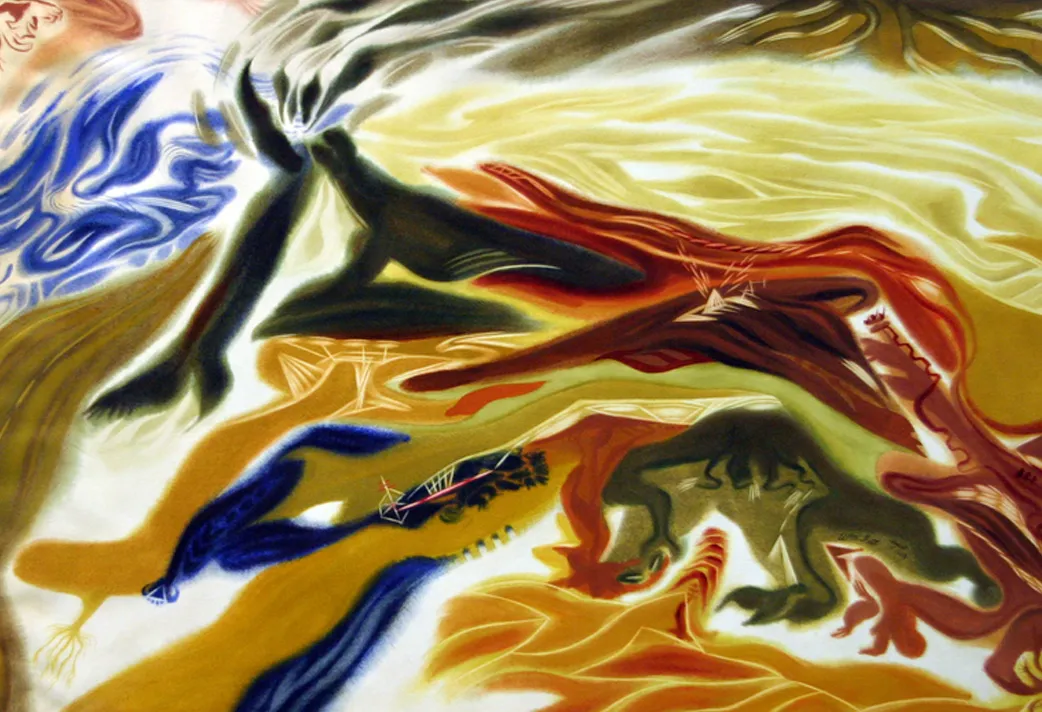
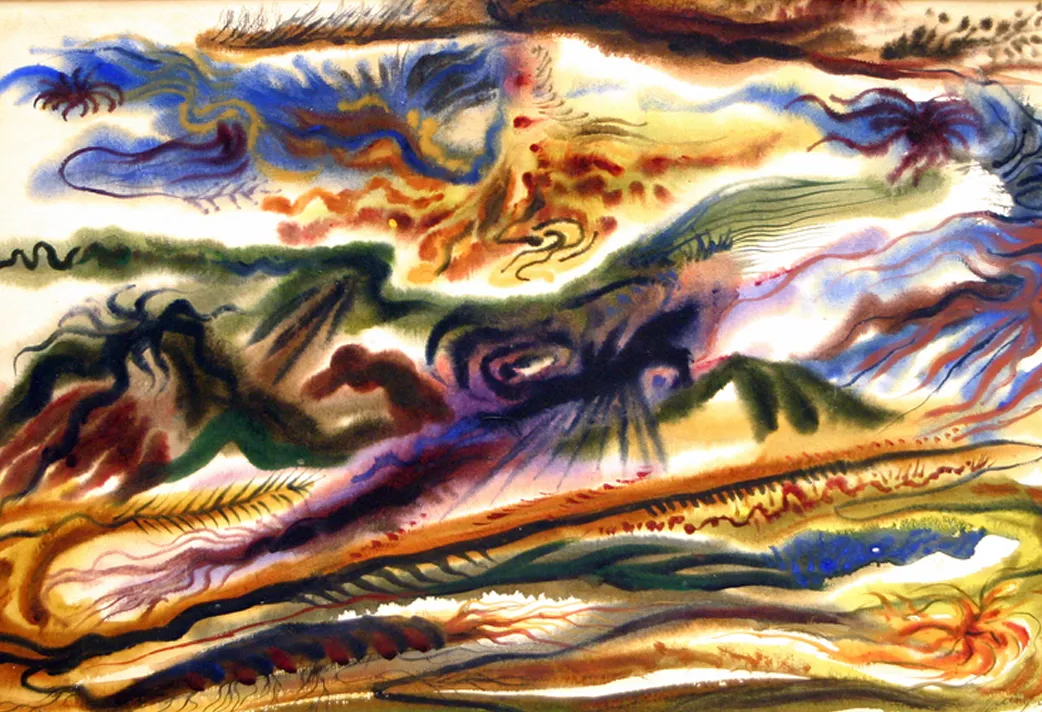
WILLIAM FETT (Sep. 22, 1918 Ann Arbor, Michigan- Sep. 10, 2006 Mexico City, Mexico) was an artist of American origin, based in Mexico. Considered himself as Romantic, Surrealist and outsider, He is best known for his landscape paintings, especially those portraying Mexican nature. His painting, “Landscape of Michoacán” (1942), is an impressive representation of Fett´s technical mastery of watercolor and is currently part of the New York MoMA collection.
Fett began painting in his early school years. It was a teacher who recommended him to apply to the Art Institute of Chicago School where he studied and graduated in 1941. After winning a $2000, fellowship to travel to Mexico, he arrived in 1941 to Michoacán and was fascinated by the beautiful landscapes which would become an inspiration in his career. William Fett maintained a close relationship with Mexico, a country that significantly influenced his artistic work. One excellent example of Fett’s appreciation for Mexico is shown in his painting “Mexican Landscape” From the Amon Carter Museum of American Art collection.
During his time in Mexico, Fett established strong friendships whit Wolfgang Paalen, Esteban Francés, Gordon Onslow Ford, Eva Sulzer, Alice Rahon and Remedios Varo, surrealist artists who sought refuge in Mexico, and other personalities such as the poet Benjamin Peret. His first marriage to Carmela Molina, daughter of Andrés Molina Enríquez, and his second marriage to Catalina Videgaray (both Mexicans) also strengthened his connection to this country where he was able to learn and develop his style taking him to his highest performance.
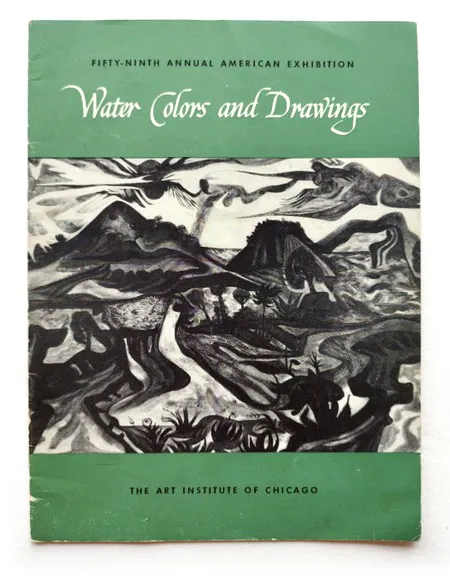
During his early years as an artist, he achieved recognition in solo exhibitions at the Durlacher Brothers Gallery in New York in 1943, 1946, and 1948 The positive response resulted in exhibitions and acquisitions of his artworks by the New York Museum of Modern Art, the Art Institute of Chicago, Whitney Museum of American Art NY, and other institutions. Some of his Mexican watercolors achieve the honor of being exhibited in a one-man room at the Art Institute of Chicago 55th Annual American Exhibition in 1944. His Watercolor Mexico Landscape was the front cover for the 59th Annual American Exhibition of the Art Institute of Chicago catalog.
In 1946 he was appointed as a professor in the School of Fine Arts at the University of Washington in St. Louis, Missouri a position he served until 1981, when he retired as Professor Emeritus of Fine Arts. From 1982 through 1983, he was acting Professor of Painting at the San Antonio Art Institute in Texas . After his success and recognition of his talent during the 1940s Fett left the mainstream rejecting the commercial artworld as an outsider focusing on his personal work which is now been revalorized by the public.
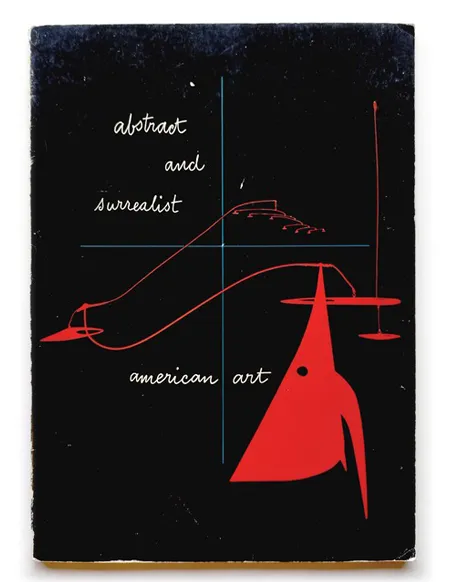
Fett is best known for his landscapes, especially those portraying Mexican nature. He is a classic example of a modern romantic artist and was one of the few American abstract surrealists.
Over time, Fett developed his style. Nowadays, he is best known for his exquisite use of expressive lines and his luminous watercolor technique.
Surrealism Surrealism is an artistic movement that sought to transcend the reality through the imaginary and irrational. In this sense, Fett adopted techniques and styles that allowed for a more authentic and personal expression in his art. Moreover, Wolfgang Paalen, considered the introducer of surrealist painting in Mexico, who had previously been part of André Breton’s surrealist circle in Paris in the 1930s, invited Fett as a contributor for the art magazine DYN. The magazine enlisted several associated thinkers and artists, including Miguel Covarrubias, César Moro, Henry Miller, Anaïs Nin, Gordon Onslow Ford, and Robert Motherwell. Each edition of the magazine was complemented by illustrations from a plethora of artists, including Manuel Álvarez Bravo, Alice Rahon, William Baziotes, Motherwell, Roberto Matta, Jackson Pollock, William Fett, Harry Holtzman, and Henry Moore.